Your Comprehensive Maliau Basin Travel Guide

I grew up with a very active family that loves the outdoors. Our idea of fun includes rafting, paddleboarding, mountain climbing, and nature photo walks with our trusty cameras.
That’s why when my brother suggested that we go to the Maliau Basin Conservation Area for vacation, I had stars in my eyes. We were all so excited for the trip, and it didn’t disappoint.
So if you’re a nature lover in search of your next big adventure or already planning a trip to Maliau Basin, read on for everything you need to know about Maliau Basin.
What’s in Maliau Basin?
Maliau Basin is a beautiful rainforest in Sabah that’s rich in biodiversity. With over 80 different mammal species, a hundred different kinds of birds, and 2000 plant species, this is a good destination for people who want to see nature in its untouched form.
It’s called Maliau Basin because it has a crater-like shape surrounded by a steep slope. The conservation area is protected by the Sabah Forestry Enactment, and efforts are underway to declare it a UNESCO Heritage Site.
It has gorgeous, multi-tiered waterfalls that would take your breath away. If you want a break from the hustle and bustle of the city, this is definitely worth a visit.
Where is Maliau Basin?
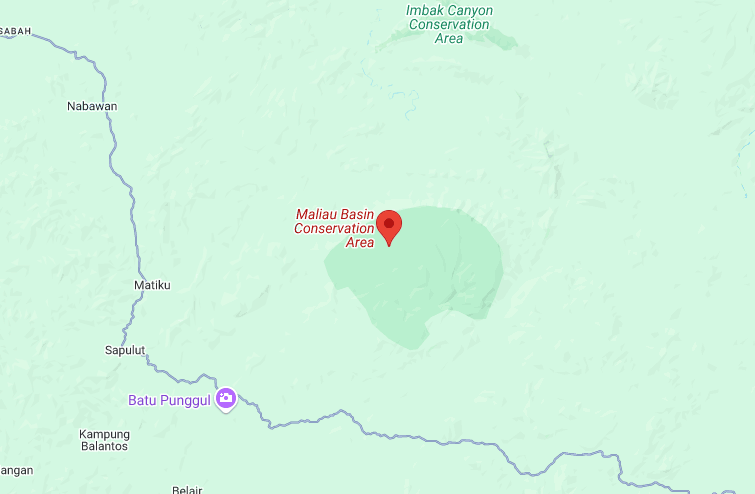
Maliau Basin is in the Tongod District. You can find it near the center of the state of Sabah.
Things to Know
Office Address: Yayasan Sabah Complex, 12th Floor, Tun Mustapha Tower, 88817 Kota Kinabalu
Contact: +60 17 488 435 (phone); [email protected] (email)
How To Get to Maliau Basin
By plane: Get on a flight to Tawau from Kota Kinabalu, which typically takes an hour. Once you arrive at Tawau Airport, it’s a 4-hour drive to get to Maliau Basin. Airport transfers are available. You can coordinate transportation with the Maliau Basin Conservation Area Office directly.
By car: You can drive from Kota Kinabalu, but it would take much longer. It takes approximately 6 hours via the Keningau–Kalabakan route. From the gate, it will be a 45-minute drive to the Maliau Basin Study Center.
Since you’ll be passing through unpaved roads, use a 4-wheel drive vehicle to make your life easier. If it can’t be helped, a non-4-wheel drive car can still pass through those roads as long as it’s not lowered.
Best Time to Visit Maliau Basin
The best time to go to Maliau Basin is during the dry season, from March to September. Since you will need to walk from one attraction to the next, it would be much easier to do so when the terrain is dry.
Please note that tours here are available all year round. So no worries if you’re only available outside of these months.
How to Book a Maliau Basin Tour
– Media credit: sabahtourism
You can book your great adventure to Maliau Basin through the Maliau Basin Conservation Area Office. Check out the packages they offer:
Other authorized agents such as Sticky Rice Travel, Amazing Borneo, River Junkie, or Audley Travel.
Each travel agency will have its own set of tour packages, so feel free to inquire and check out the best deal for you based on your needs and preferences.
An example of a tour package is the 5D4N tour at Amazing Borneo. The rate per person for the whole trip is around RM 8300.
This package is inclusive of transportation (to and from our hotel in Kota Kinabalu), meals, accommodation, permits and conservation fees, user fees, VHF radio rental, and a tour guide.
If you need a porter for your things, check out the rates below. This is exclusive of the tour fee.
Things to Do at Maliau Basin
Go trekking in the jungle
– Media credit: maliaubasin_official
Trekking at Maliau Basin is like being in real-life Jumanji. Most of what we did at Maliau Basin was to warm up, go trekking, take in the sights, and recover from the trek.
The Maliau Basin trek can be challenging, especially for beginner hikers, but it’s not impossible. There will be guides, and you can even book a porter in advance who will help you carry your things.
There will be winding, narrow, and slippery trails on this hike. While that can be difficult, the good thing is that the pace is relaxed and there are plenty of stops to rest and enjoy the view.
Enjoy the night safari
– Media credit: maliaubasin_official
On the first day of our tour, we went walking at night and saw animals like wild boars, civets, and sambar deer. A guide accompanied us, and he was armed with flashlights, helping us spot animals easily!
Aside from walking, you can also opt for an open-truck safari. Just to set expectations, wildlife sightings are not guaranteed. The chances of seeing them will depend on the time of year and whether it’s your lucky day.
For us, the uncertainty makes it even more exciting because every trip can be vastly different. Just remember not to make too much noise and not to wear strong scents to avoid scaring the wildlife away.
Grab your binoculars and go bird-watching
– Media credit: maliaubasin_official
While people rarely appreciate the art of bird watching, it’s one of my favorite things to do because of how peaceful it is. I also got the chance to see birds I’ve never seen in my life, like the Chestnut-breasted malkoha and Rhinoceros Hornbill.
There’s no one area here that is best for birding since you get ample opportunities for bird sightings everywhere. But for me, I had the best experience in the primary forest and the Maliau Sky Bridge Canopy Walk.
For this, you need a keen eye and your binoculars—there are over 270 species of birds in the Maliau Basin!
Check out the waterfalls
– Media credit: maliaubasin_official
Unofficially, Maliau Basin has the most waterfalls in all of Malaysia. As you go trekking, don’t forget to take a moment to see Maliau Falls, a beautiful seven-tiered waterfall, as well as Takob Akob Falls, Ginseng Falls, Fowzi Falls, or Giluk Falls. They’re perfect for picture-taking.
Where to Stay in Maliau Basin
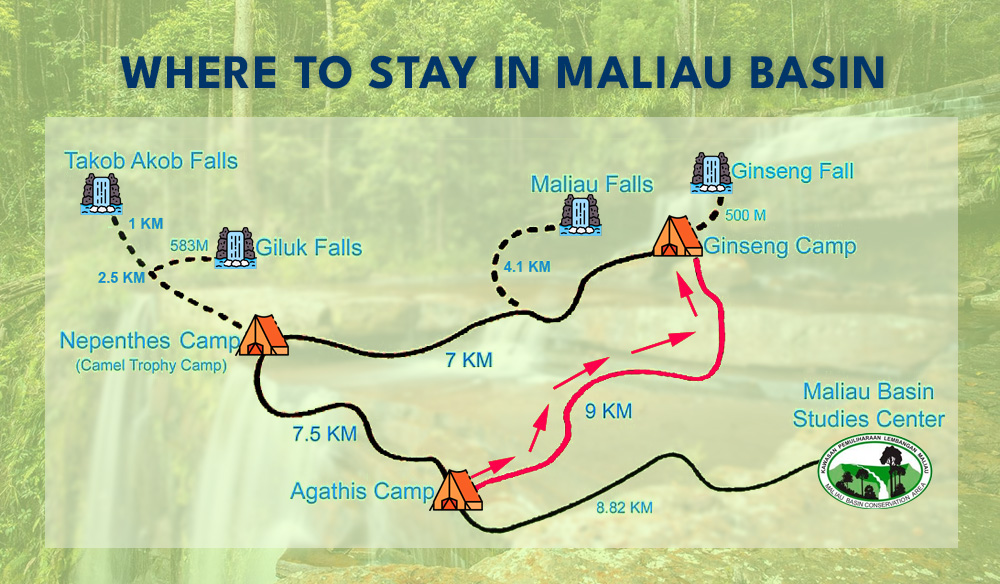
During our tour of Maliau Basin, we had to transfer from one accommodation to the next as we explored each area. These are our notes for each accommodation.
The Maliau Basin Study Center
– Media Credit: maliaubasin_official
This is the first stop; you can choose your room when you book the tour, depending on your budget and preferences. Slots fill up fast, so it’s important to book in advance to ensure you get the room you’re eyeing.
Agathis Camp
– Media Credit: _.nyloo
You won’t stay here overnight, but this is usually the first stop with luggage storage. In the past, this was used as a base camp by trekkers before they started their journey. Locals say that this camp was damaged by elephants in the past and was never fixed.
Nepenthes Camp (formerly Camel Trophy Camp)
– Media Credit: aizaharwani_mj
If you’re doing the 5D4N tour just like we did, you will go here after going to Agathis camp. The trek will take around 6 hours. Once you get here, you’ll get the chance to decide if you want to rest or trek for three more hours to see the Giluk and Takob Akob Falls.
Afterwards, you’ll have to go back to Nepenthes Camp because dinner will be served there.
Ginseng Camp
Ginseng Camp is the third stop if you’re taking the 5D4N tour. This is 6 km away from Nepenthes Camp and 9 km away from Agathis Camp. This is close to Ginseng Falls.
They have hammocks and basic facilities here where you can rest for a while.
Where to Eat in Maliau Basin
For your Maliau Basin tour, all meals are included in the tour package. Make sure to communicate all food allergies or restrictions ahead of time. To be safe, you can bring light snacks like nuts or granola bars to keep you fueled during all that trekking.
Sample Itinerary for Maliau Basin
The itinerary for this trip will depend on your interests. Some go to the Maliau Basin for research purposes. If that’s you, you’ll have to directly coordinate with the conservation center to go over the requirements for a permit.
For our trip, we went to the conservation area to enjoy nature, camp, and go hiking. So, this sample itinerary we have will reflect that. You can customize your plans based on what you prioritize to get out of this trip.
What to Pack for Maliau Basin
Here’s a checklist of things we brought to our trip that were helpful for us.
- Insect repellent
- Sunblock
- Hat
- Snacks that are high in calories
- Water purification tablets
- Water bottle
- Lightweight waterproof backpack
- Toiletries
- Microfiber towel
- Extra socks
- Enough change of clothes
- Raincoat
- Personal medicine and a first aid kit
- Cash
- Sleeping bag with a lightweight blanket
- Binoculars
- Camera
We suggest packing light since there will be a lot of trekking on this trip. This will ensure you won’t get tired as easily. Still, don’t forget the essentials because there will be no access to stores during the trip.
Important Reminders for Your Maliau Basin Trip
To ensure your Maliau Basic trip is a safe and happy one, we all need to abide by the rules and reminders.
- All animals and plants are protected. Do not disturb the animals or harm them in any way. Keep a respectful distance. Do not pick plants and bring them home.
- Weapons, traps, and explosives are strictly prohibited.
- Don’t damage any fixtures in the area, such as signs, bridges, or walls.
- Be as quiet as you can when trekking to avoid scaring wildlife. This will also increase your chances of seeing them.
- Don’t wear strong perfume and use unscented toiletries to not scare off animals in the forest.
- Don’t litter. Your trash is your responsibility.
- Don’t wander alone. Make sure to let your guide know your location at all times.
- Listen to the tour guide when they give their safety briefing.
- Make sure to get accident insurance before going on this trip, which includes a helicopter lift in case of emergencies. It’s better to be safe than sorry.